Translate

Sunday, 30 October 2016

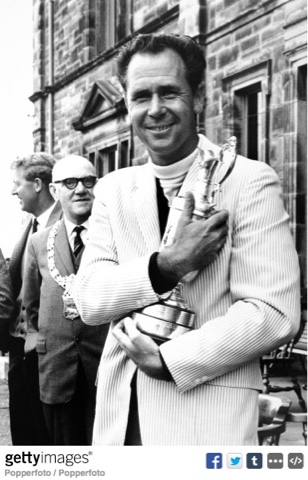
Champagne Tony Lema

Tony Lema just might have become one of the greats of the game had he not been killed in a plane crash. His book, Champagne Tony's Golf Tips, lay on a bindery platform ready for shipment as he perished that Sunday in 1966. He never had a chance to hold the final product in his hands.

You just never know. The older I get, and the more I play golf, the more I am inclined to wonder about predestination, or fate, as did Bobby Jones. It may all just be a great coincidence, or accident, but you really have to wonder. But I digress.

What I picked up from Tony's book was that he was yet another top hand player, who believed the key to success was the back of the left hand, and therefore the clubface, driving straight down the target line through impact. He had plenty of company among the greats of the game in this respect--Bobby Jones, Byron Nelson, Sam Snead, Jack Nicklaus...

He also stressed balance as being key. And I liked what he wrote about the stance. He suggested that, for the full shots, you place your feet as you would if you were going to do deep knee bends. That is the most balanced and stable stance for any of us. I tried it and found it to be great advice. I have been inclined to use the Hogan stance, often toeing the front foot out as much as forty five degrees, and squaring up my back foot. This effectively shortened my swing and restricted my hip turn.

It's funny how you never stop learning in this game.

Saturday, 29 October 2016

The Most Neglected Area of the Game

I've been reading Sam Snead's book, The Education of a Golfer. Sam wrote about his ailing back, a condition called spinal ostosis, which certainly made life difficult and painful for him and made him wonder whether his playing days were numbered.

Sam told the story of a trip to play in Brazil's national championship. Sam had been offered five thousand dollars plus expenses to play. However, if he won, the deal was that the first place money of two thousand dollars would not go to Sam, but be included in the guaranteed five grand. Sam, despite his bad back, shot an opening round 71, which was criticized at dinner that night by the businessman who had put up the appearance money.

Sam told the businessman that if he wanted to see him really play, he should let him have a shot at the prize money. The businessman agreed, thinking Sam was probably too far back to catch the leaders, including Roberto Di Vicenzo. Sam then went on a tear and won the tournament going away setting the course record and winning by eleven strokes. He was a money player.

What Sam relied on to win was not long hitting, but his short game. He put his drives in play and then used bump and run approaches to handle the rock-hard greens that wouldn't receive a standard approach shot. He also pitched and chipped like a demon. He wrote the following:

    "Year in and year out, a strong short-iron game--or lack of it--has decided how well I've scored as much as any other factor. The longer anyone plays golf, the more this is true. If you have a physical disability, or you're past the age where your hips turn freely, or have grown a paunch, you'll always have trouble hitting the long woods well. And when a man passes the age of forty, the odds are that his putting nerve will slip. But there's still that big shot-saving area left around the green. The heart of scoring is from 150 yards out from the pin, and the place where most matches are decided is even closer in--from 40 to 50 yards of the hole. It's also the most neglected area in the game.
     That should never be, because age, sex, size, or strength doesn't count for much when it comes to the short approaches. I know a sixty-year-old woman who can chip and pitch and run up with almost a pro's ability."

Reading this, as a guy with a chronic back problem and a paunch, I'm convinced that the only way I'm going to play well is to hone a good short game. There are no drivers, or swing changes, or exercises that are going to make me able to hit it long any more. Those days are gone. But I can still get better from 150 yards and in; and especially around the green. 

If I can forget about my long game and build up an even better repetoire around the greens, who knows, I might actually get better, rather than just older. The short game is, according to Sam, the most neglected area in the game. That may be so for most amateurs; but it certainly isn't the case for the guys who are making their living at this game.

Friday, 28 October 2016

Don't Relax

Bobby Jones wrote his book Golf is my Game some ten years after he had been afflicted with a crippling disease that had made it impossible for him to play any longer. When he wrote the book golf was still a consuming interest in his life. Even though he could no longer play, the game still fascinated him and he wanted to share his knowledge with other golfers.

Consider what he wrote about the game and how he believed it should be played in his first chapter:

    "Golf has a very great and sometimes mystifying appeal to busy men. Some of its most ardent devotees are men of affairs whose lives are filled with responsibilities for making important decisions. To thise who know little of golf, it is difficult to explain how a game so apparently frivolous could interest men such as these.
     To those who know something of the game, there is no mystery at all. Golfers know, and have known for a long time, that when playing golf, it is almost impossible to think of anything else. The most complete rest for the mind, and the most effective renewal of mental keenness and vigour, come not from thinking of nothing, but from putting one's mind completely upon fresh and stimulating activities. It is, therefore, the all-absorbing challenge of golf which makes it such an effective agent of mental therapy.
     In this view, then, it seems to me that we are defeating or detracting from the effectiveness of the game as recreation when we urge people to relax, take it easy, or be casual and carefree on the golf course. I think we should urge them to do just the opposite--to put themselves wholeheartedly into their play. What they want and need most from the game can be had only when the intense concentration upon the play helps to sweep away the problems, worries, and even troubles of everyday life."

So, there you have it. Golf is best played and enjoyed when, as Arnold Palmer once wrote, you "play it to the hilt." There is nothing wrong with taking the game seriously, even if you might not be a scratch player. It is in concentrating on playing the game to the best of your ability that you reap the greatest benefits from it. 

Wednesday, 26 October 2016

Don't Be Worried

Some golfers, and especially new golfers, tend to be worried about playing with strangers, or golfers that play better than they do. Most golfers actually have an inferiority complex when it comes to their game. Sure there's the odd fellow who thinks he is better than he really is; but most golfers are worried about embarrassing themselves when they tee it up.

The fact is that there is no requirement to be a really good player in order to be an acceptable companion on the golf course. Bobby Jones, who regularly teed it up with average players when he wasn't trying to win championships, wrote about this subject in his book Golf is my Game. He wrote:

    "It is by no means necessary to play well to be an entirely acceptable golfing companion, but you must try. You must be able to keep the ball in play. You must not dilly-dally around. You must be ready to play your shot when your turn comes, and you must be aware of and respectful of the rights of others in your game.
     If you can fit this bill, you need have no hesitancy about playing in any company. Indeed, the better players will be delighted to help and encourage you in the game. They like golf, and they will want you to like it, too. The better your partner, the more tolerant he is likely to be."

So, don't be worried about teeing it up with better players or strangers. You don't need to play well. You just need to keep up and do your best to be an amiable and respectful companion. No golfer worth his salt looks down his nose at new players, or players less competent than himself. If you run into someone who does, avoid him. He's the one with the problem.

Sunday, 23 October 2016

The Best Luck Bobby Jones Ever Had

Bobby Jones came to believe in predestination or fate. He understood that in order to win big championships you had to be good; but you also needed some luck. Most golfers who have competed understand this to be true.

In order to become a champion, you don't simply need luck on the golf course, you need some luck to get to the point where you are good enough to compete with the best players of your day. You need opportunity to play and practise. You need to play against other good players. And you need good role models, mentors, and/or instructors. 

As I write this, I think of Ben Hogan who, perhaps as much as any great champion, dug it out of the dirt himself. But even Ben had Byron Nelson to compete against from the time the two of them met as caddies in Texas. Without Byron, who knows how good Ben would have been.

As for Bobby Jones, the luckiest thing that ever happened to him in golf was the arrival of Stewart Maiden at East Lake from Carnoustie to replace his brother Jimmy as the professional at East Lake. In his book, Down the Fairway, Bobby wrote:

    "I wish I could say that a strange thrill shot through my skinny little bosom when I swung at a golf ball for the first time; but it wouldn't be truthful. I do not remember the first time I hit a golf ball, or hit at one; and as I recall it the game did not make much of an impression on me, except that I used to get mad enough to dance in the road when a wild shot went under a little bridge covered with briers across the ditch which was the second hole. I liked baseball much better, and played golf, or what we called golf, be ause of a dearth of boys in the neighbourhood with whom to play baseball...
     We moved back to East Lake the next summer, in 1908, and here I ought to be able to record another sensation, because soon afterward Stewart Maiden came to be professional at the club, and that was the luckiest thing that ever happened to me in golf, which is saying a lot, because my entire career, if it may be called a career, has been lucky. There were times, during what one writer called my seven lean years, when I fancied most of the luck was bad luck; but I was wrong. Some people can learn only by having education drubbed into them; and I want to say right now that I never learned anything from a match that I won. Not jntil the seven lean years were over, at any rate... But the best luck I ever had in golf was when Stewart Maiden came from Carnoustie, Scotland, to be professional at the East Lake club... there was nothing sensational about Stewart. He said very little and I couldn't understand a single word of what he said; he was not long over from Scotland...
     No-- there wasn't any sensation, any more than when I swung the first time at a golf ball. Stewart was just another little Scot, like Jimmy, only Scotcher. But it wasn't long before I was following him about the East Lake course and watching him... When I followed Stewart, I didn't carry even one club. I just watched him. I never was conscious of studying his play, or trying to play like him. I liked golf pretty well; he was the best player at the club; and I liked watching him perform. He paid little or no attention to me, and after tagging along four or five holes I would leave the match and go back to our house -- we had moved into a cottage inside the club property, right by the thirteenth green of the old course--and get a cap full of balls and my mashie and putter and go out to the thirteenth green and pitch them all on and putt them all out, over and over again. It was pretty good practice, I suppose. I liked to pitch the ball, and as I recall I could get it close to the pin with a fair consistency... Lately I have caught myself thinking about those long, sunny afternoons, pitching balls at the pin on the old thirteenth green, and I've wished I could get the ball up there as accurately now, from proportionate distances. The short pitch is the weakest spot in my game, these last few years. Maybe I've got away from Stewart Maiden's method that was so clearly before me in thise days when I had so little else to think about...
     Now, I suppose all the time I was watching Stewart play golf the imitative faculty which seems inherent in most children was at work, and that I began hitting the ball as he did, so far as my limitations would permit. Dad says I was a natural mimic in those days, and I remember he used to amuse a veranda full of people at times by inspiring me to get out on the lawn and imitate the swing of this player or that one-- usually someone in the gathering."

Bobby Jones didn't have some sort of mystical experience when he first hit a golf ball; but he was lucky enough to have Stewart Maiden to watch and imitate, and a green by his house to hone his short game skills. 

So, when you think of Bobby Jones, don't forget Stewart Maiden. Without that quiet little Scotsman, Bobby might never have become one of golf's greatest champions.
Saturday, 22 October 2016

Bobby Jones' Beginnings

Bobby Jones was a fascinating character. He began life as a sickly child--possibly one of the least likely candidates to become one of, if not the greatest champions of all time. Speaking of his beginnings, Bobby wrote in his book Down the Fairway:

    "Judging from certain photographs I must have been an odd-looking youngster. I started out with an over-sized head and a spindly body and legs with staring knees, and some serious digestive derangement which caused my parents and six or seven doctors a deal of distress. Dad says I didn't eat any real food until I was five years old, but I don't remember about that. I must have been pretty frail because I don't remember any playmates while we lived on Willow Street in Atlanta, except Camilla, our fat cook and nurse, and her fat brother, who was blacker than Camilla; and Camilla's beau. I used to enjoy the visits of Camilla's brother, who sat on the back veranda while I rode my velocipede there, and taught me to swear and call Camilla's beau all kinds of curious names. Occasionally Camilla took me to her home for a little visit and I have a distinct recollection of falling off the rear veranda of her house head first into a garbage can. It is lucky for me that I do not have to trust everything to memory, for I have no independent recollection of ever getting out of the can. I had a big black and white Collie named Judge, who caused me a lot of trouble by following people away from our house; he would follow anybody, and I had to go and bring him back. I liked the ice-man too--that was Camilla's beau--and when he came to deliver the ice I liked to hold my hands under the block as he sawed it, and catch the saw dust (I thought it was that) and eat it."

Bobby was born in the old South well before any real progress was made in terms of integration. I have often wondered what he thought about the society to which he was born and what he thought about the racial injustices that existed. I have never found any specific comments from him about these things. But what we do know is that his first friends were black folk, whom he obviously had real affection for and no doubt contributed to the wonderful person he became.

He even learned to cuss from Camilla's brother. By all accounts, he learned that lesson well; because he was famous as a teenager for his colourful outbursts on the golf course. I wonder if Camilla, her brother, and her beau ever dreamt that this funny-looking little white boy would become one of the most famous sportsmen of all time. It would have been interesting to talk to them about it.

Thursday, 20 October 2016

A Sound Stroke

What constitutes a sound stroke for a right-handed player? Bobby Jones had the following to say about it in his book Bobby Jones on Golf:

    "In a sound golf stroke, the back of the left hand is visible at the instant of impact to an observer standing in front of the player. It is important that this hand should drive straight through the impact position in an effort to direct the head of the club precisely along the line of play. The turning action, which begins to take place an appreciable space after contact, does so then because the player's muscles relax after the effort of hitting, and because his swing has then reached the limit of motion it can accommodate along the line of flight."

That is why I called my blog Top Hand Golf. In a sound swing, the top hand pulls the club down the target line, the back of that hand facing the target through impact. All good players do this whether they are aware of it or not. The correct stroke is a backhanded action with the left hand. Bobby also wrote:

    "The correct stroke causes the club head to approach the ball from inside the line of play. The factors making this possible are the forward shift of the hips during the downstroke, maintaining a bend in the right arm that keeps the right elbow close to the side of the body, and the backhand nature of the stroke dominated by a strong pull from the left side. These are the factors that make it necessary or inevitable that at the instant of impact the hands should be on a line with, or ahead, of the club head, and that the left hand should carry through the ball without beginning to turn."

If you are having trouble with slicing or hooking the ball, or you are just unhappy with the consistency of your ballstriking, look to your left hand. Keep the back of that top hand driving straight down the target line.  As Lee Trevino also taught, where the back of the left hand goes is where the club face goes. And Byron Nelson had the back of his left hand driving down the target line as his primary swing thought during his magic year in 1945 when he won eighteen times, including eleven in a row. Once he discovered the importance of the top hand, he never looked back.